Pure Protein Bar Nutrition Facts: 20g Protein, 190 Calories per Bar — Every Flavor Compared, Budget Case Made
Pure Protein bars deliver 20g of protein and approximately 190 calories per 50g bar at roughly $1.50 to $2.00 per bar retail — the most affordable mainstream protein bar in the US. Verified nutrition facts for every core flavor, an honest look at the whey + collagen protein blend, and a direct comparison with Quest, Barebells, ONE Bar, and RXBAR on price and macros.
The short answer
Our top protein bar picks
Editor-selected and ready to buy. As an Amazon Associate we may earn from qualifying purchases.
Shopping for Pure Protein? Birthday Cake Protein Bar · Chocolate Mint Cookie Protein Bar · Chocolate Deluxe Protein Bar
 15g protein
Choco Chip Sandwich AMMMAZE Protein Bars
Amazon returns policy · secure checkout
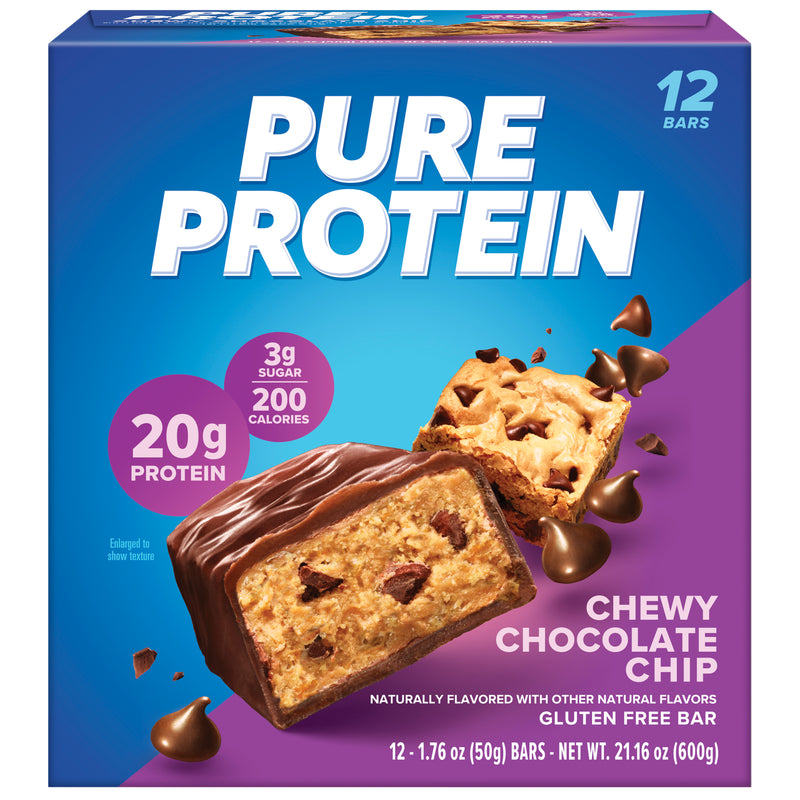 20g protein
Chewy Chocolate Chip Protein Bar
Amazon returns policy · secure checkout
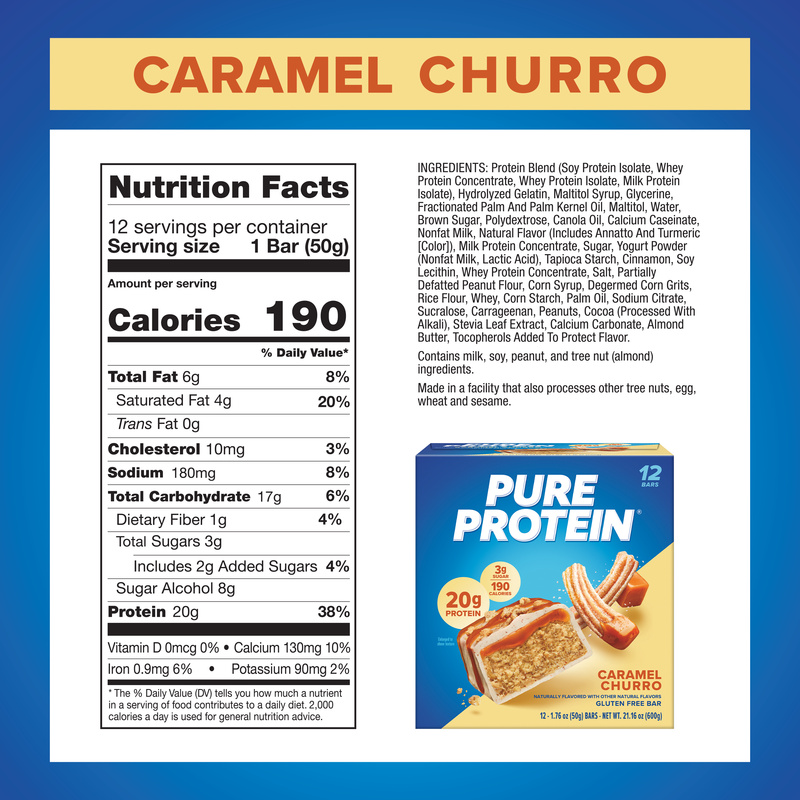 20g protein
Caramel Churro Protein Bar
Amazon returns policy · secure checkout
Pure Protein Bar Nutrition Facts: All Core Flavors Compared (Per 50g / 1.76oz Bar)
Every standard Pure Protein bar is a single 50g (1.76oz) serving. The figures below are verified from Walmart, Target, Walgreens, and pureprotein.com product pages. Sugar alcohol counts (primarily maltitol) are included in total carbohydrates on the label but broken out here because they affect net carb calculations. Most flavors deliver 20g of protein for 190 calories; the Chocolate Deluxe flavor stands out at 21g for 200 calories. Numbers marked (~) are close approximations; confirm the specific panel on your package for exact values.
| Flavor (50g bar) | Calories | Protein | Total Carbs | Fiber | Total Sugar | Maltitol | Fat |
|---|---|---|---|---|---|---|---|
| Chocolate Peanut Butter | 190 | 20g | 17g | 1g | 3g | ~5g | 7g |
| Chewy Chocolate Chip | 190 | 20g | 18g | 1g | 2g | ~5g | 5g |
| Chocolate Deluxe | 200 | 21g | 17g | 1g | 2g | ~5g | 5g |
| Birthday Cake | 200 | 20g | ~17g | ~1g | 3g | ~5g | ~6g |
| Brookie | 180 | 19g | ~16g | ~1g | 2g | ~5g | ~6g |
| Caramel Churro | ~190 | ~20g | ~17g | ~1g | 2g | ~5g | ~6g |
Key observations: Chocolate Peanut Butter carries more fat (7g) than most other flavors because of the peanut content — this makes it slightly more calorie-dense but also more satiating, and it is the most popular flavor in the lineup. Chocolate Deluxe is the only core flavor to reach 21g of protein at 200 calories, driven by its higher-protein formulation. All core flavors listed are gluten-free. Seasonal or licensed flavors (such as the Fruity PEBBLES and Cocoa PEBBLES collaborations) may carry slightly different nutrition counts — confirm those against the label. Net carbs per bar work out to approximately 11 to 12g for the core flavors: take total carbs (~17 to 18g), subtract fiber (~1g) and maltitol (~5g).
Pure Protein Bar Protein Blend: Whey, Milk Protein, and the Collagen Caveat
Pure Protein bars list four protein sources in their blend: whey protein isolate, milk protein isolate, whey protein concentrate, and hydrolyzed collagen. The first three are complete proteins — they contain all nine essential amino acids including tryptophan and the branched-chain amino acids (leucine, isoleucine, valine) that drive muscle protein synthesis. Hydrolyzed collagen, by contrast, is an incomplete protein: it lacks tryptophan entirely and is low in leucine and the other BCAAs. Collagen is a common protein-boosting additive that increases the gram count on the label without contributing equivalent nutritional value per gram compared with whey or milk protein.
Because protein sources are listed in descending order by weight (FDA requirement) and whey protein isolate comes first, the dominant source in the blend is complete-protein whey. Pure Protein does not disclose the exact breakdown between whey and collagen, so the precise fraction of the 20g that is complete versus incomplete protein is not publicly available from the label alone. The practical implication: for most health and weight-management goals, the 20g blend works well as a protein snack. For athletes specifically optimizing muscle protein synthesis — where amino acid completeness and leucine delivery per gram matter most — a pure-whey or whey-isolate-dominant bar like Quest provides a higher-quality protein dose per gram. This is the same caveat that applies to Barebells and Built Bar, both of which also include collagen in their blends.
Sweeteners: Maltitol and Sucralose Explained
Pure Protein bars achieve their low-sugar profile through two sweetening agents: maltitol syrup and sucralose. Maltitol is a sugar alcohol present at approximately 5 to 6g per bar, responsible for most of the candy-like sweetness. Sucralose (the artificial sweetener in Splenda) is present in smaller amounts to boost perceived sweetness. Two things to understand about this combination:
- Maltitol and blood sugar: Maltitol has a glycemic index of approximately 36 — roughly half that of table sugar (GI ~65) — and a caloric contribution of about 2 calories per gram (versus 4 cal/g for regular sugar). Unlike erythritol (used in Quest bars), which is almost fully excreted without being metabolized, maltitol is partially absorbed and contributes to blood glucose. People managing blood sugar carefully, especially on a strict ketogenic diet, should factor in maltitol’s partial glycemic contribution when estimating net carbs.
- GI tolerance: Maltitol at doses of 5 to 10g per day is generally well tolerated by most people. At higher doses — two or more bars per day — it can cause bloating, gas, or a laxative effect in sensitive individuals, the same risk that applies to Barebells bars which also use maltitol as the primary sugar alcohol. Erythritol (in Quest) and real sugar (in Built Bar) carry lower GI-complaint rates at equivalent doses.
If avoiding artificial sweeteners is a priority, Built Bar (real sugar, no artificial sweeteners) and RXBAR (dates, no added sweeteners of any kind) are the cleanest alternatives. See our protein snacks without added sugar guide for more options.
Pure Protein vs Quest vs Barebells vs ONE Bar vs RXBAR: Full Comparison
Here is how Pure Protein stacks up against the other major mainstream protein bars on the metrics that drive most purchase decisions. All figures are per single bar as labeled.
| Bar (per bar) | Cal | Protein | Protein / 100 cal | Total Sugar | Fiber | Sweeteners | Est. price / bar |
|---|---|---|---|---|---|---|---|
| Pure Protein Chewy Choc. Chip (50g) | 190 | 20g | 10.5g | 2g | 1g | Maltitol, sucralose | $1.50–$2.00 |
| Quest Choc. Chip Cookie Dough (60g) | 190 | 21g | 11.1g | 1g | 12g | Erythritol, sucralose, stevia | $2.50–$3.00 |
| Barebells Cookies & Cream (55g) | 200 | 20g | 10.0g | 1g | ~3g | Maltitol, sucralose, Ace-K | $2.50–$3.00 |
| ONE Bar Birthday Cake (60g) | 220 | 20g | 9.1g | 1g | 9g | Maltitol, sucralose | $2.50–$3.00 |
| RXBAR Chocolate Sea Salt (52g) | 210 | 12g | 5.7g | 13g | 5g | Dates (natural, no added) | $3.00–$3.50 |
The headline takeaway: Pure Protein and Quest deliver nearly identical protein-to-calorie ratios (10.5g vs. 11.1g per 100 cal) at the same 190 calories per bar, but the macros get there very differently. Quest has 12g of fiber (which drives satiety) and uses erythritol (a lower-glycemic-impact sweetener than maltitol). Pure Protein has only 1g of fiber — so it will leave most people hungrier sooner despite the similar protein count — and uses maltitol, which has more glycemic impact than erythritol. The price gap is the clearest differentiator: Pure Protein at $1.50 to $2.00 per bar is 25 to 40 percent cheaper than Quest at $2.50 to $3.00 per bar. For detailed breakdowns on each competitor, see our guides for Quest protein nutrition, Barebells protein nutrition, ONE Bar nutrition, and RXBAR nutrition.
The Budget Case: Is Pure Protein Worth It?
The core argument for Pure Protein is straightforward: it delivers nearly the same protein-to-calorie ratio as Quest for meaningfully less money at the same retail stores. Here is what that looks like on a monthly budget:
- At $1.75 per bar (a typical Walmart or Walgreens price), $50/month buys approximately 28 Pure Protein bars — about 560g of protein across the month.
- At $2.75 per bar (a typical Quest single price at the same stores), the same $50 buys approximately 18 Quest bars — about 378g of protein for the same budget.
That is a meaningful gap. For people who eat a bar every day as a protein top-up, Pure Protein extracts more total protein servings from a fixed budget. Amazon Subscribe & Save and Walmart multi-packs bring the per-bar price below $1.50 for popular flavors, widening the advantage further. Walgreens frequently runs buy-one-get-one promotions on Pure Protein multi-packs that lower the effective price below $1.25 per bar.
The trade-offs to weigh against the price advantage: lower fiber (1g vs. Quest’s 12g, meaning less satiety per bar); maltitol sweetening rather than erythritol (more glycemic impact); a protein blend that includes collagen. For anyone whose main goal is hitting protein targets affordably and who is not specifically optimizing satiety-per-calorie or protein quality-per-gram, Pure Protein delivers genuinely good value. For anyone who needs the bar to keep them full for two or more hours, Quest or a whole-food option like Greek yogurt or cottage cheese is a better choice. See our best high-protein snacks for weight loss guide for a broader comparison.
Is Pure Protein Bar Healthy? Who It Is For
For general health and weight management at one bar per day, yes — Pure Protein bars are a legitimate high-protein convenience snack with no significant red flags. The 20g protein, ~190 calories, and 2 to 3g of sugar fit well into calorie-deficit eating, daily protein target management, or replacing higher-sugar snacks. The protein comes primarily from whey (a high-quality, complete source), even if the blend also includes collagen. The bars are gluten-free, shelf-stable, and available everywhere without ordering online.
The honest caveats:
- Low fiber: At 1g of fiber per bar, Pure Protein does not aid satiety the way Quest does at 12g. If you need a bar that keeps you full for two or more hours, Pure Protein is less effective for that goal than Quest, regardless of the protein count.
- Collagen in the protein blend: Not a dealbreaker for most health goals, but if you are specifically optimizing for muscle protein synthesis, a pure-whey or whey-isolate-dominant bar provides a higher-quality protein dose per gram.
- Maltitol sweetening: At one bar per day, most people tolerate it without GI issues. At two or more bars daily, some people experience bloating or loose stools from the accumulated maltitol load.
- Artificial sweetener present: Sucralose is in the formula. If avoiding artificial sweeteners entirely is a priority, see our Built Bar review (real sugar, no artificial sweeteners) or RXBAR review (dates only, no sweeteners of any kind).
Best fit: Anyone buying protein bars regularly who wants to stretch their budget without giving up 20g of protein per bar. Active adults, gym-goers on a budget, people in a calorie deficit who want a shelf-stable snack. Consider an alternative if: you need the bar to carry high fiber for satiety (choose Quest); you want clean sweeteners with no artificial additives (choose Built Bar or RXBAR); you are optimizing protein quality for muscle building (choose Quest, which uses pure whey isolate); or you need strict keto compatibility (maltitol partially metabolizes). For all of these scenarios, our best protein bars of 2026 guide covers every major option side by side.
Frequently Asked Questions
How much protein is in a Pure Protein bar?
Most Pure Protein bar flavors deliver 20g of protein per 50g (1.76oz) bar. The Chocolate Deluxe flavor is an exception at 21g of protein for 200 calories. The protein blend includes whey protein isolate, milk protein isolate, whey protein concentrate, and hydrolyzed collagen. Because collagen is an incomplete protein that lacks tryptophan, the effective complete-protein content is slightly lower than the 20g label count, though complete-protein sources (whey and milk protein) are listed first and likely dominate the blend.
Are Pure Protein bars gluten-free?
Yes. The standard Pure Protein bar lineup is certified gluten-free. This is one of the product’s cleaner attributes: 20g of protein in a gluten-free format at a budget price point is a combination that is not always easy to find. Confirm the specific package label if you have celiac disease or a severe gluten sensitivity, as manufacturing facility cross-contamination practices can vary.
Do Pure Protein bars have a lot of sugar?
No — most core flavors have 2 to 3g of total sugar per bar. The sweetness primarily comes from maltitol syrup (a sugar alcohol, approximately 5g per bar) and sucralose (a small amount of artificial sweetener). Neither maltitol nor sucralose is counted as sugar on the Nutrition Facts panel. Total carbohydrates of approximately 17 to 18g per bar include the maltitol; net carbs per bar work out to approximately 11 to 12g once you subtract fiber (~1g) and maltitol (~5g).
Are Pure Protein bars keto-friendly?
They can fit into a low-carb eating pattern, but with caveats. At approximately 11 to 12g of net carbs per bar (17 to 18g total carbs minus ~1g fiber minus ~5g maltitol), they are not strict keto — similar to Quest bars on net carb count. The larger consideration for strict keto is that maltitol, unlike erythritol, partially metabolizes and can raise blood glucose. People on a strict ketogenic diet should be cautious about including maltitol-sweetened bars without tracking their individual glycemic response.
Where can I buy Pure Protein bars cheapest?
Walmart typically sells 6-count multi-packs for about $10 to $12, working out to $1.67 to $2.00 per bar. Walgreens regularly runs buy-one-get-one deals on mixed-flavor packs that can bring the effective price below $1.25 per bar. Amazon Subscribe & Save on 18-count boxes brings the per-bar cost to around $1.35 to $1.50 for popular flavors. Costco carries Pure Protein in bulk boxes at the best per-bar price among major retailers. Single bars at convenience stores typically run $2.00 to $2.50 — significantly higher than multi-pack pricing at grocery or club stores.
Bottom line: Pure Protein bars deliver 20g of protein and approximately 190 calories per bar at a retail price ($1.50 to $2.00 per bar) that no mainstream competitor matches. The protein blend includes collagen alongside whey and milk protein isolate — the same incomplete-protein caveat that applies to Barebells and Built Bar. Sweetness comes from maltitol and sucralose; the low-fiber count (1g) means less satiety per bar than Quest (12g fiber). For budget-focused protein supplementation at one bar per day, Pure Protein is the clearest pick in the category. For better satiety, cleaner sweeteners, or higher protein quality per gram, compare them against Quest and Built Bar in our best protein bars of 2026 guide, or browse the full protein snacks directory.
Shop our top protein bar picks
Editor-selected high-protein options related to this guide. As an Amazon Associate we may earn from qualifying purchases.
Shopping for Pure Protein? Birthday Cake Protein Bar · Chocolate Mint Cookie Protein Bar · Chocolate Deluxe Protein Bar
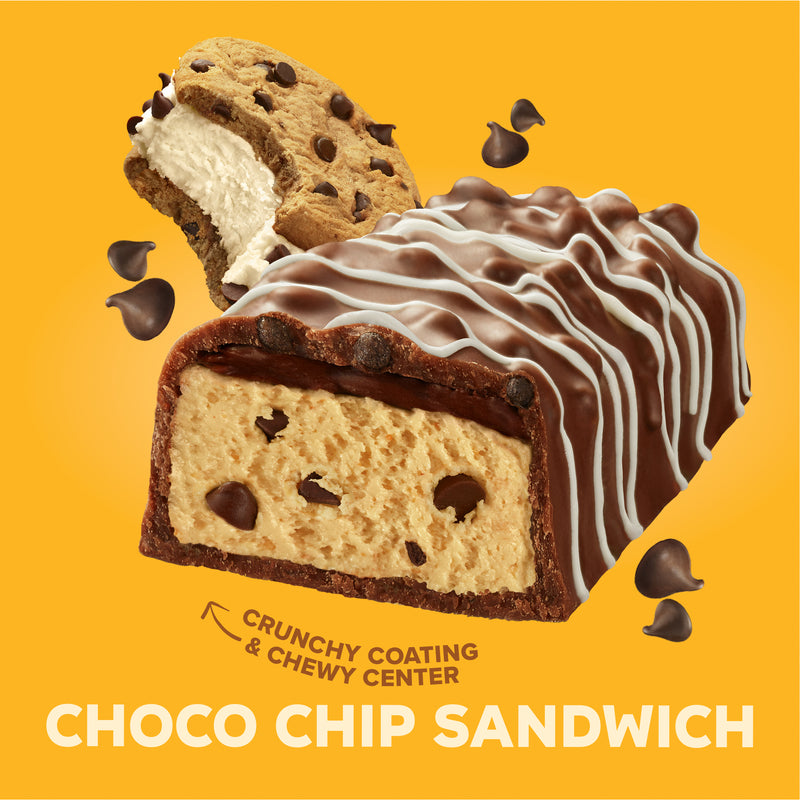 15g protein15g protein
Choco Chip Sandwich AMMMAZE Protein Bars
Amazon returns policy · secure checkout
20g proteinChewy Chocolate Chip Protein Bar
Amazon returns policy · secure checkout
Tags
High Protein Snacks Pro Editorial Team
Independently researched and editorially reviewed. We compare real nutrition labels and never accept payment for coverage.
Get the best new protein snacks in your inbox
Weekly picks and honest reviews — no spam, unsubscribe anytime.
More from the journal
Premier Protein Bar Nutrition Facts (2026): 30g Protein Per Bar, All Flavors Compared and Bar vs Shake
Premier Protein’s 30g Protein Bars deliver the same 30g of protein as their RTD shake—but at 340 calories versus the shake’s 160 calories, with 40g of total carbohydrates versus 5g. Verified 2026 nutrition facts for the full 30g bar lineup, a bar-vs-shake macro comparison, sweetener breakdown (sucralose, not stevia), and a side-by-side against DAVID, Quest, and Kirkland at the same protein tier.
Read more
Which Protein Bar Has the Most Fiber? 19 Bars Ranked, From No Cow's 15g to Built Bar's Under 1g (2026)
No Cow delivers more fiber than any protein bar we've verified — 15g in a single ~60g bar — while Quest and Kirkland Signature tie for second at 12g. But the real story is what fiber reveals about the 20g-protein cluster from our grams ranking: DAVID Gold, Pure Protein, and Built Bar all carry 17g to 28g of protein yet come in at roughly 1g of fiber or less. We ranked all 19 verified bars by grams of fiber, sourced entirely from each bar's own published nutrition facts on this site.
Read more
Which Protein Bar Has the Most Protein? All 20 Bars Ranked by Grams, Not Ratio (2026)
DAVID Gold has more protein than any bar we've verified — 28g in just 150 calories. But the real story is the cluster right behind it: 13 different mainstream bars all deliver exactly 20g of protein, and among them calories range from 170 to 280 and sugar ranges from 1g to 16g. We ranked all 20 verified bars by total grams of protein — not protein-per-calorie ratio — using the already-published label data from every bar review on this site.
Read more