Atkins Protein Bar Nutrition Facts: Strong vs High Protein, All Flavors Compared — Lowest Net Carbs in the Market
Atkins now makes two distinct protein bar lines: the Strong bar (20g protein, 2–3g net carbs, erythritol) and the High Protein bar (15–16g protein, 3–5g net carbs, sucralose). Verified 2026 nutrition facts for every major flavor, a breakdown of the sweetener stack that actually matters for blood sugar, and a head-to-head against Quest, ONE Bar, and RXBAR.
The short answer
Our top high-protein picks
Editor-selected and ready to buy. As an Amazon Associate we may earn from qualifying purchases.
Shopping for Atkins? Protein Shakes
 10g protein
 20g protein
 12g protein
This article is informational, not medical advice. Individual blood sugar responses vary. Always verify nutrition facts on your specific product label, as formulations can change. Consult your healthcare team before using any food product as part of a diabetes management plan.
Atkins Strong Bars: Nutrition Facts (All Flavors)
The Strong line is Atkins’ premium protein tier: 20g of protein per 60g bar, sweetened with erythritol + sucralose (not maltitol), and built around 8g of prebiotic fiber from polydextrose. These are the bars to pick if you want the highest protein yield and the most favorable sweetener stack for blood glucose control.
| Flavor | Calories | Protein | Total Carbs | Fiber | Net Carbs | Sugar | Fat |
|---|---|---|---|---|---|---|---|
| Chocolate Chip Cookie Dough | 230 | 20g | ~20g | 8g | 3g | 1g | 12g |
| Birthday Cake | ~230 | 20g | ~19g | 8g | 2g | 2g | ~11g |
Numbers for Chocolate Chip Cookie Dough are cross-verified against MyNetDiary and the Atkins product page. Birthday Cake figures are drawn from the Atkins site (~) and retailer listings; confirm the label on your specific lot. Net carbs are calculated as Total Carbs − Dietary Fiber; Atkins also subtracts erythritol in its own net carb calculation (see the Net Carbs section below for why that matters). The protein blend in both Strong flavors is soy protein isolate + whey protein isolate + acid casein — a complete multi-source blend that covers all essential amino acids.
Atkins High Protein Bars: Nutrition Facts (All Flavors)
The High Protein line is the mainstream Atkins bar available at most grocery and mass-market retailers. These bars run 15–16g of protein, come in more flavor variety than the Strong line, and use sucralose + vegetable glycerin as their sweetener stack (no maltitol in the current formulation). Net carbs range from 3 to 5g depending on flavor and fiber content.
| Flavor | Calories | Protein | Total Carbs | Fiber | Net Carbs | Sugar | Fat |
|---|---|---|---|---|---|---|---|
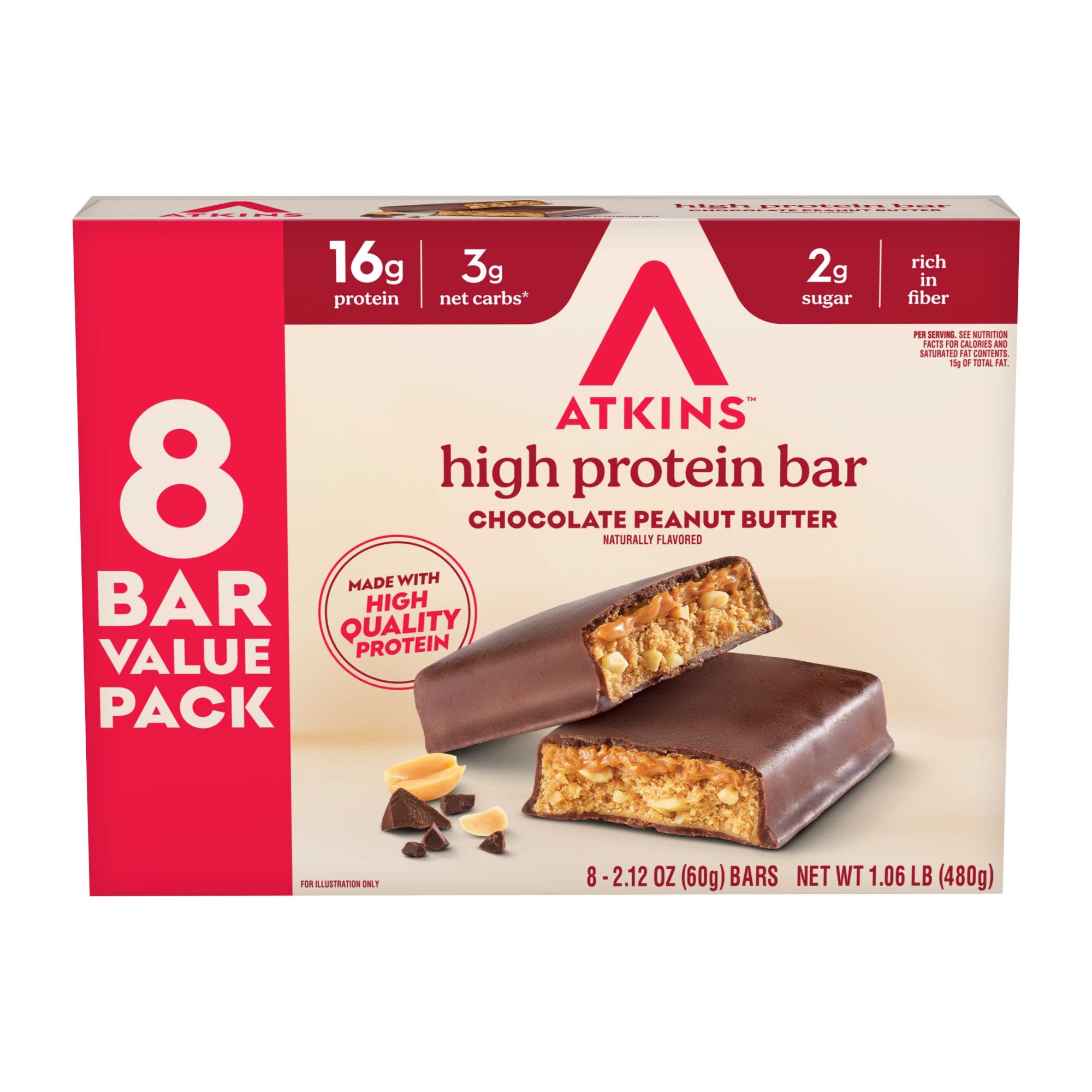
| Chocolate Peanut Butter | 240 | 16g | 23g | 12g | 3g | 2g | 15g |
| Peanut Butter Granola | 220 | 16g | 18g | 6g | 4g | 1g | 11g |
| Blueberry Greek Yogurt | 190 | 15g | 19g | 10g | 5g | 3g | 9g |
| Strawberry Shortcake | ~190 | 15g | ~18g | ~9g | 3g | 1g | ~9g |
| Blueberry Soft Baked | 190 | 15g | ~19g | ~10g | 4g | 2g | ~8g |
| Cookie Fusion | ~220 | 15g | ~18g | ~6g | 4g | ~2g | ~11g |
All figures are cross-verified from Walmart listings, Amazon nutrition panels, and the Atkins product pages. Numbers marked (~) are close approximations from retailer databases; confirm the label on your specific lot and flavor. The Chocolate Peanut Butter flavor is the most fiber-dense at 12g per bar, which gives it a stronger glucose-buffering effect relative to its calories. The protein blend in the High Protein line is soy protein isolate + gelatin + whey protein isolate + whey protein concentrate — a similar multi-source approach to the Strong line but at a lower total protein yield per bar.
How Atkins Calculates Net Carbs — and Why It Matters
Atkins was the company that popularized the “net carbs” concept in the US, and their bars label net carbs prominently. Understanding what goes into that number is critical for anyone using it to manage blood glucose or ketosis.
The Atkins net carb calculation subtracts two categories from total carbohydrates:
- Dietary fiber — Standard practice. Fiber is not digested as carbohydrate and does not raise blood glucose. All bars subtract fiber; this is well-established and consistent across the industry.
- Sugar alcohols and glycerin — Atkins subtracts these entirely in its net carb figure. Whether this is appropriate depends on the specific sweetener used.
For the Strong bars: the primary sugar alcohol is erythritol, which has a glycemic index of approximately 1 — essentially zero. Erythritol is absorbed in the small intestine and excreted largely intact, causing negligible impact on blood glucose. Subtracting erythritol from the carb count is legitimate for blood sugar purposes; it is standard keto practice and is supported by research.
For the High Protein bars: the sweetener is sucralose (not a sugar alcohol) and vegetable glycerin. Sucralose has no glycemic impact and zero calories. Glycerin (glycerol) has a glycemic index of approximately 3 — also very low. Atkins’ net carb calculation subtracting glycerin is reasonable but somewhat more conservative than the erythritol case; glycerin is partially metabolized to glucose, but the amount in a single bar is small enough that its glycemic impact is generally negligible in practice.
The important historical nuance: older Atkins snack bars (particularly some of the “Endulge” candy-bar style products) used maltitol as a primary sweetener. Maltitol has a glycemic index of 35–52 — meaningfully lower than table sugar but not negligible. Subtracting maltitol from the net carb count the way Atkins does overstates how keto-friendly those products are. The current High Protein and Strong lines do not use maltitol in their formulations (the Chocolate Peanut Butter ingredient list shows sucralose; the Strong bars show erythritol + sucralose). If you buy an Atkins bar, check the ingredient list for “maltitol” — its presence in an older or specialty product changes the glycemic picture significantly. In the mainstream High Protein and Strong lines as of 2026, you will not find it.
Polydextrose (listed as “prebiotic fiber” in the Strong bars) is a soluble fiber, not a sugar alcohol. It is absorbed in the colon and fermented by gut bacteria rather than spiking blood glucose. Research shows polydextrose has no significant impact on glycemic index, and it is appropriately subtracted as fiber rather than as a sugar alcohol in net carb calculations.
Atkins vs Quest, ONE Bar, and RXBAR: Head-to-Head
Here is how the Atkins Strong bar compares against the three most similar competitors at the 20g protein tier. All figures per single bar.
| Bar (per bar) | Cal | Protein | Fiber | Net Carbs | Sugar | Primary Sweetener | Glycemic Impact |
|---|---|---|---|---|---|---|---|
| Atkins Strong (CCC) | 230 | 20g | 8g | 3g | 1g | Erythritol + sucralose | Very low |
| Quest Bar (avg) | 190 | 21g | 12g | 4–5g | 1g | Erythritol + sucralose | Very low |
| ONE Bar (avg) | 210 | 20g | 9g | ~13g | 1g | Erythritol + sucralose | Very low |
| RXBAR (avg) | 210 | 12g | 5g | 19g | 13g | None (dates) | Moderate |
Atkins Strong vs Quest: The two bars use the same sweetener approach (erythritol + sucralose) and the same protein tier (20g vs 21g). Quest wins on fiber (12g vs 8g) and on calories (190 vs 230), making Quest more protein-efficient at 11.1g of protein per 100 calories vs Atkins Strong’s 8.7g. Quest is also cheaper per bar in most retail environments ($1.50–$2.00 vs $1.75–$2.25 for Atkins Strong in a 4-count box). On sweetener safety for blood glucose management, the two are equivalent: both are erythritol-based and perform well on CGM data shared in keto communities. For people who prioritize protein efficiency and want the fewest calories, Quest is the stronger choice. For people who find the Atkins brand more appealing or prefer the Strong bar’s texture, it is a legitimate alternative at the same glycemic impact level.
Atkins High Protein vs Quest: The High Protein bar drops to 15–16g of protein vs Quest’s 21g, with similar net carb ranges (3–5g). Quest remains the stronger protein-per-calorie option; the Atkins High Protein bars are most competitive on price at bulk or value pack sizes ($1.31/bar in an 8-count pack vs $1.50+/bar for Quest in equivalent pack sizes) and flavor variety. The Blueberry Greek Yogurt and Strawberry Shortcake flavors offer a lighter, snack-like option that Quest doesn’t directly match.
Atkins vs RXBAR: These two are positioned differently. RXBAR uses whole-food ingredients (dates, egg whites, nuts) with no sweetener, which means 13g of actual sugar from dates and a moderate glycemic impact. Atkins bars deliver lower blood glucose response, more protein (15–20g vs 12g), and fewer net carbs (2–5g vs 19g). RXBAR wins on ingredient simplicity and clean-label appeal. For blood glucose management specifically, Atkins is the better choice; for people who want recognizable ingredients and no sweeteners of any kind, RXBAR is the alternative. See our full RXBAR nutrition facts guide and ONE Bar nutrition facts guide for more on those bars. For the broadest comparison across goals, see our best protein bars of 2026 roundup.
Are Atkins Protein Bars Keto-Friendly?
The Strong and High Protein lines are broadly compatible with a ketogenic diet, with some nuance:
- Strong bars (2–3g net carbs): Fit comfortably within even strict keto macros (typically 20–50g net carbs per day). The erythritol sweetener has no measurable impact on ketosis, and polydextrose is fermented in the colon rather than metabolized as glucose. These are among the most keto-compatible packaged protein bars in the mass market.
- High Protein bars (3–5g net carbs): Also compatible with most keto approaches, though the higher fat content (9–15g per bar) makes them calorie-dense for a snack at 190–240 calories. The sucralose sweetener has no metabolic impact on ketosis. The Chocolate Peanut Butter flavor’s 240 calories and 15g of fat make it more appropriate as a meal replacement than a light snack.
- Watch for older Atkins products with maltitol: Some specialty or legacy Atkins bars — particularly the Endulge candy-bar style line — still use maltitol. Those are less appropriate for strict keto or blood glucose management. Always check the ingredient list.
“Keto-friendly” in practice depends on your total daily carb budget and individual glucose response. People tracking net carbs can generally fit a Strong bar at 2–3g without exceeding a 20g daily limit even with other low-carb foods. See our best keto protein bars guide for a cross-brand comparison.
Who Should (and Should Not) Buy Atkins Protein Bars
Best fit:
- Low-carb and keto dieters who want a convenient packaged bar with verified low net carbs and a sweetener that doesn’t raise blood glucose — the Strong line at 2–3g net carbs and erythritol + sucralose is one of the most keto-compatible bars in the mass market
- People managing type 2 diabetes or prediabetes who want protein bars with minimal glycemic impact — the Strong line’s erythritol-based sweetener and 8g of prebiotic fiber together produce very low glycemic response compared to maltitol-based bars or bars sweetened with dates
- Budget-conscious buyers who want low net carbs — the High Protein line in value packs runs ~$1.31/bar, making it one of the cheapest ways to get 15–16g of protein with under 5g net carbs per bar
- Buyers who want more flavor variety at the lower protein tier — the High Protein line covers Chocolate Peanut Butter, Peanut Butter Granola, Blueberry Greek Yogurt, Strawberry Shortcake, and more, which gives more options than the two-flavor Strong line
Consider an alternative if:
- You want the maximum protein-per-calorie ratio — Quest bars deliver 21g of protein at 190 calories (11.1g per 100 cal) vs Atkins Strong at 20g of protein and 230 calories (8.7g per 100 cal); if protein efficiency is the primary metric, Quest wins
- You want higher fiber for satiety — Quest bars deliver 12g of fiber vs Atkins Strong’s 8g; more fiber means better glucose buffering and more fill per bar
- You avoid soy protein — the current Atkins bar formulations use soy protein isolate as a primary protein source; people with soy allergies or who prefer to avoid soy should look at bars using whey isolate only, such as think! or Pure Protein
- You want a whole-food ingredient list — Atkins bars use isolated protein fractions, polydextrose, and synthetic sweeteners; RXBAR or Perfect Bar are better fits for buyers who prioritize recognizable food ingredients
Frequently Asked Questions
How much protein is in an Atkins protein bar?
It depends on which line you choose. The Atkins Strong bars deliver 20g of protein per 60g bar, sourced from a blend of soy protein isolate, whey protein isolate, and acid casein. The Atkins High Protein bars deliver 15–16g of protein depending on flavor, using a similar soy + whey blend. Both lines are complete protein sources (covering all essential amino acids) because they combine plant (soy) and animal (whey, casein) protein sources.
Do Atkins bars use maltitol?
The current Atkins Strong and High Protein lines do not use maltitol. The Strong bars are sweetened with erythritol + sucralose; the High Protein bars use sucralose + vegetable glycerin. Some older or specialty Atkins products (particularly the Endulge candy-bar style line) do use maltitol — always check the ingredient list. Maltitol has a glycemic index of 35–52, which is meaningfully higher than erythritol (GI ≈1), and its presence changes the blood sugar picture significantly.
Are Atkins protein bars good for diabetics?
The Atkins Strong bars are among the better protein bar choices for people managing blood glucose: erythritol sweetener (GI ≈1), 8g of prebiotic fiber that slows glucose absorption, 2–3g net carbs, and 20g of protein. The High Protein bars are also reasonable at 3–5g net carbs with sucralose (no glycemic impact). Individual glucose responses vary significantly based on insulin sensitivity, what else is in the meal, and flavor. The most reliable approach is to check your glucose before and after eating the bar on your first try. Work with your healthcare team for personalized guidance. For a full comparison of protein bars ranked by blood sugar impact, see our best protein bars for diabetics guide.
What is the lowest carb Atkins protein bar?
The Atkins Strong Birthday Cake bar is currently the lowest net carb option in the mainstream Atkins bar lineup, at 2g net carbs per bar (using Atkins’ calculation of total carbs minus fiber and erythritol). The Atkins Strong Chocolate Chip Cookie Dough comes in at 3g net carbs. Both are from the Strong line at 20g of protein per 60g bar. In the High Protein line, Chocolate Peanut Butter is the lowest at 3g net carbs, aided by its unusually high 12g of fiber content.
How do Atkins bars compare to Quest bars for keto?
Both use erythritol + sucralose and deliver net carbs in the 2–5g range, making them similarly compatible with a ketogenic diet. The key practical differences: Quest delivers more protein (21g vs 20g), more fiber (12g vs 8g), and fewer calories (190 vs 230) per bar, making it more protein-efficient and typically more filling. Atkins Strong is still a legitimate keto choice, particularly if you prefer its texture or flavor profile. On blood glucose impact, the two are functionally equivalent given the same sweetener stack. For a broader comparison, see our Quest protein bar nutrition guide.
Bottom line: Atkins protein bars have genuinely evolved from the maltitol-heavy early 2000s formulations. The current Strong bars (20g protein, 2–3g net carbs, erythritol + sucralose, 230 calories) are among the most blood-sugar-friendly packaged protein bars in the mainstream market — competitive with Quest on glycemic impact and sweetener quality, if not quite matching Quest on protein efficiency or calorie density. The High Protein line (15–16g protein, 3–5g net carbs, sucralose, $1.31+/bar in value packs) is a price-competitive option for buyers who want low net carbs at a lower cost per bar. The critical caveat: always check the ingredient list for maltitol before buying any Atkins bar — some specialty and legacy products still use it, and its partial glycemic impact is not captured by the “0g sugar” label. The Strong and High Protein lines available at Walmart, Target, and major grocery chains as of 2026 are formulated without it. Browse more low-carb options in our protein snacks directory or see our best keto protein bars guide for a full category comparison.
Shop our top high-protein picks
Editor-selected high-protein options related to this guide. As an Amazon Associate we may earn from qualifying purchases.
Shopping for Atkins? Protein Shakes
 15g protein
Endulge Protein Bar - Chocolate Peanut Butter
Amazon returns policy · secure checkout
10g protein20g proteinTags
High Protein Snacks Pro Editorial Team
Independently researched and editorially reviewed. We compare real nutrition labels and never accept payment for coverage.
Get the best new protein snacks in your inbox
Weekly picks and honest reviews — no spam, unsubscribe anytime.
More from the journal
Best Keto Protein Bars 2026: DAVID Bar Leads at 0g Net Carbs and 28g Protein — Quest, IQBAR, and 7 Picks Ranked
DAVID bar leads at 0g labeled net carbs and 28g protein in just 150 calories — the most keto-efficient bar at mainstream retail in 2026. Quest follows at 3–4g net carbs with 20–21g protein; IQBAR wins on cleanest sweeteners at 2–3g net carbs. Seven picks ranked by verified net carbs, with honest warnings on IMO fiber and maltitol bars that quietly kick you out of ketosis.
Read more
Premier Protein Bar Nutrition Facts (2026): 30g Protein Per Bar, All Flavors Compared and Bar vs Shake
Premier Protein’s 30g Protein Bars deliver the same 30g of protein as their RTD shake—but at 340 calories versus the shake’s 160 calories, with 40g of total carbohydrates versus 5g. Verified 2026 nutrition facts for the full 30g bar lineup, a bar-vs-shake macro comparison, sweetener breakdown (sucralose, not stevia), and a side-by-side against DAVID, Quest, and Kirkland at the same protein tier.
Read more
Which Protein Bar Has the Most Fiber? 19 Bars Ranked, From No Cow's 15g to Built Bar's Under 1g (2026)
No Cow delivers more fiber than any protein bar we've verified — 15g in a single ~60g bar — while Quest and Kirkland Signature tie for second at 12g. But the real story is what fiber reveals about the 20g-protein cluster from our grams ranking: DAVID Gold, Pure Protein, and Built Bar all carry 17g to 28g of protein yet come in at roughly 1g of fiber or less. We ranked all 19 verified bars by grams of fiber, sourced entirely from each bar's own published nutrition facts on this site.
Read more