Magic Spoon vs Nature Valley Protein Granola (2026): Nearly Identical Protein, 8× the Sugar
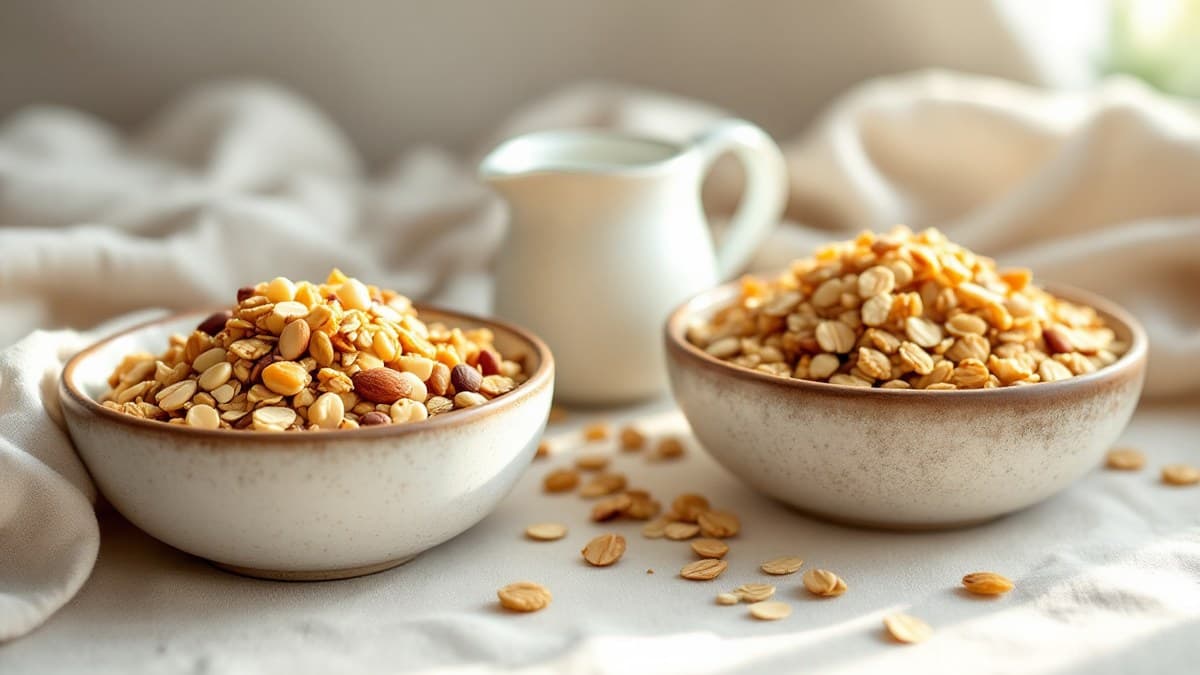
Magic Spoon Grain-Free Protein Granola delivers 14g of protein for 260 calories and 2g of sugar per 2/3 cup. Nature Valley Protein Granola Oats & Honey delivers 13g of protein for 280 calories and 16g of sugar (15g added) per 2/3 cup. Verified 2026 head-to-head from each brand's own nutrition label — the protein numbers are within one gram, but the sugar and carb load differ by an order of magnitude. Cost per gram of protein, who each fits, and the honest trade-offs.
The short answer
Our top protein cereal picks
Editor-selected and ready to buy. As an Amazon Associate we may earn from qualifying purchases.
Buy the products in this guide: Variety 6 · Variety 6 - Protein Cereal - 6 box case · Treats Super Pack
 10g protein
 12g protein
 11g protein
Protein Pastries - 24 Pastries
Amazon returns policy · secure checkout
Affiliate links — if you buy through them we earn a small commission at no extra cost to you. The facts and picks below are our own.
Magic Spoon vs Nature Valley Protein Granola: The Quick Verdict
- Most protein per bar of granola: Magic Spoon by one gram (14g vs 13g) at Nature Valley’s slightly larger serving. At the same 60g weight, Magic Spoon is ahead by ~2g.
- Fewest calories per serving: Magic Spoon (260 vs 280) at its 60g serving. On a same-weight basis, Magic Spoon is still lower.
- Lowest total sugar and added sugar: Magic Spoon by a wide margin — 2g of total sugar with 0g added, versus Nature Valley’s 16g total (15g added). That is roughly 8× the total sugar and, in practical terms, all of it.
- Most fiber per serving: Magic Spoon — 7g vs Nature Valley’s 4g. That is a real satiety difference.
- Fewer grams of fat: Nature Valley — 7g vs Magic Spoon’s 13g. Magic Spoon’s fat comes almost entirely from its nut base, so it is fat you may actually want.
- Widest retail availability: Nature Valley — sold in nearly every grocery store, plus Target, Walmart, and Amazon.
- Grain-free / gluten-free: Magic Spoon — it uses no oats. Nature Valley is oat-based and contains soy.
- Cheapest per gram of protein: Nature Valley by a large margin — roughly one-third the cost per gram of protein of Magic Spoon (see the math below).
Side-by-Side Nutrition Facts
All figures below come from each brand’s currently published nutrition label. Nature Valley’s serving is 2/3 cup at 65g; Magic Spoon’s serving is 2/3 cup at 60g — a small but real difference to keep in mind when you compare the two side by side.
| Per labeled serving | Magic Spoon Grain-Free Protein Granola (2/3 cup, 60g) | Nature Valley Protein Granola, Oats & Honey (2/3 cup, 65g) |
|---|---|---|
| Calories | 260 | 280 |
| Protein | 14g | 13g |
| Total carbs | ~20g | 41g |
| Fiber | 7g | 4g |
| Net carbs (carbs − fiber) | ~13g | ~37g |
| Total sugar | 2g | 16g |
| Added sugar | 0g | 15g |
| Total fat | 13g | 7g |
| Saturated fat | ~1.5g | 1g |
| Sodium | ~110mg | 170mg |
| Sweetener | Allulose (and a touch of monk fruit) | Sugar, honey, molasses |
| Protein source | Nut and seed base + added protein | Whole grain oats + soy protein isolate |
| Contains gluten / oats | No | Yes (whole grain oats) |
| Contains soy | No | Yes (soy protein isolate, soy lecithin) |
The single most important row is total sugar: 2g vs 16g at similar serving weights, with Nature Valley’s 15g of added sugar showing up as sugar, honey, and molasses on the ingredient list. That is not a labeling artifact — you would need to eat about eight servings of Magic Spoon to match one serving of Nature Valley on total sugar.
Standardized at 60g: The Fairest Same-Weight Comparison
Because Magic Spoon’s labeled serving is 60g and Nature Valley’s is 65g, the raw per-serving table above modestly flatters Nature Valley’s calorie and protein numbers — you get a bit more food. Rescaling Nature Valley down to Magic Spoon’s 60g serving gives the cleanest apples-to-apples read.
| Per 60g of granola | Magic Spoon | Nature Valley (rescaled) |
|---|---|---|
| Calories | 260 | ~258 |
| Protein | 14g | ~12g |
| Total sugar | 2g | ~15g |
| Added sugar | 0g | ~14g |
| Fiber | 7g | ~3.7g |
On a strict same-weight basis, Magic Spoon delivers about 2g more protein, roughly the same calories, nearly 8× less total sugar, and about double the fiber. The trade is fat: Magic Spoon runs 13g of fat at 60g, versus roughly 6.5g in Nature Valley — but Magic Spoon’s fat is almost entirely from its nut and seed base, which is why it has more calories despite lower carbs. This is the pattern our protein granola guide flags across the whole category: front-of-bag protein claims tend to survive same-weight scrutiny, but sugar and fiber numbers do not.
Sugar Is the Real Story, Not Protein
The reason these two products end up feeling like completely different foods, despite nearly matching protein numbers, is the sweetener system. Magic Spoon uses allulose — a rare, low-calorie sugar the FDA has excluded from “total sugars” on nutrition labels because the body does not metabolize it for energy — along with monk fruit. That is why its label shows just 2g of total sugar despite tasting genuinely sweet. Nature Valley sweetens with sugar, honey, and molasses, which are conventional caloric sugars that fully count on the label. All three are on the ingredient list ahead of the soy protein isolate that provides the protein bump.
The practical impact is bigger than the label numbers alone suggest, because most people do not eat 2/3 cup of granola — they eat granola as a topper. A modest 1/3 cup (roughly 30–33g) sprinkled on Greek yogurt gives you ~1g of sugar with Magic Spoon and ~8g of sugar with Nature Valley. Do that twice a day and Nature Valley is quietly adding roughly 16g of sugar to your diet — more than most protein bars — before you count the yogurt or the fruit on top.
Cost Per Gram of Protein: Nature Valley Wins by a Lot
Using the cost-per-gram-of-protein framework from our cheapest protein snacks guide — price per serving divided by grams of protein — here is where these two land at their typical online prices.
| Per 60–65g serving | Magic Spoon (60g) | Nature Valley (65g) |
|---|---|---|
| Typical retail price per bag | ~$9–$10 for 8oz (~226g) | ~$4.50 for 11oz (~312g) |
| Servings per bag | ~3.8 | ~4.8 |
| Price per serving | ~$2.50 | ~$0.94 |
| Protein per serving | 14g | 13g |
| Cost per gram of protein | ~$0.18 | ~$0.07 |
Nature Valley is roughly one-third the cost per gram of protein of Magic Spoon at typical grocery-store pricing. That is a real gap, and it is the single strongest argument for Nature Valley: if your budget cares about grams of protein per dollar and you are not counting sugar as a hard constraint, Nature Valley is the more efficient buy. The counter is that Magic Spoon is not really competing on grams-of-protein-per-dollar — it is competing on grams of sugar per serving, which is a different problem.
The Fiber Difference Is Bigger Than It Looks
Magic Spoon’s 7g of fiber versus Nature Valley’s 4g of fiber per serving is a satiety edge that gets lost next to the flashier sugar numbers. The fiber in Magic Spoon comes from its nut and seed base along with added tapioca fiber; Nature Valley’s comes almost entirely from whole grain oats. Combined with the lower carb load, this is why Magic Spoon tends to feel more filling per bite despite similar calories — higher fiber, higher fat, lower sugar-and-starch is the classic satiety-forward profile.
If you eat granola as a snack rather than a topper, the fiber gap matters more than the small protein gap. Two servings of Nature Valley (30g protein, 8g fiber) will not keep you full as long as two servings of Magic Spoon (28g protein, 14g fiber), even though the second one has fewer grams of protein.
Ingredient Quality and Diet Fit
Magic Spoon’s Grain-Free Granola is built on a base of nuts and seeds (peanuts, almonds, cashews, sunflower seeds) with tapioca fiber, and uses allulose plus monk fruit for sweetness. That formulation makes it grain-free, gluten-free, and low in added sugar, which fits keto, low-carb, and gluten-free diets in a way Nature Valley cannot. It is not vegan (some flavors contain whey or dairy) and it is not nut-free.
Nature Valley’s Protein Granola is built on whole grain oats and soy protein isolate, sweetened with sugar, honey, and molasses. That formulation is inexpensive, widely available, and delivers real protein per dollar, but it is not gluten-free, contains soy, and is high in added sugar. It is a solid mainstream breakfast granola for people who are not restricting sugar or gluten and want the cheapest protein-per-serving option that is also easy to buy anywhere.
Which Should You Buy?
Choose Magic Spoon if…
You are watching added sugar closely, following keto or a low-carb diet, avoiding gluten, or you use granola primarily as a yogurt topper where the per-scoop sugar hit adds up over time. It is also the better pick if your goal is snacking on granola dry, since the higher fiber and fat, plus the much lower sugar, keep you fuller for longer. You are paying a premium of roughly $0.11 more per gram of protein for those benefits.
Choose Nature Valley Protein Granola if…
You want the cheapest per-gram-of-protein option in this category and can absorb the added sugar into your overall diet, or you want a grocery-store granola that is genuinely easy to buy anywhere and delivers real protein per dollar. It is also the more familiar-tasting product, closer to a traditional sweet oat granola than Magic Spoon’s crunchier, nut-forward texture. If you eat it in modest 1/3 cup portions on yogurt with fruit, the sugar hit stays in the 7–8g range per bowl, which is defensible for a lot of people.
Consider a third option if neither fits…
KIND Protein Granola sits between these two on price and delivers 10g of protein per 30g serving with roughly 5g of sugar, which is the most balanced option for people who want fewer trade-offs. See how it stacks up in our protein granola brand ranking.
Where to Buy
Both are available on Amazon; Nature Valley is also sold at nearly every grocery store, Target, and Walmart.
Affiliate links — it costs you nothing extra and supports our independent guides.
Honest Caveats on Both
- Neither is a protein bar. 13–14g of protein per 260–280 calorie serving is a granola-level protein density (around 5g of protein per 100 calories), not a bar or shake level. Use either as a topper or a component, not as the whole protein source in a meal.
- Allulose can cause digestive discomfort in large amounts. Magic Spoon’s sweetener system is well-tolerated by most people at a normal serving, but eating multiple servings back-to-back can cause bloating or loose stools for a subset of people. Try a small portion first if you have not had allulose before.
- Nature Valley’s 15g of added sugar is not trivial. That is more added sugar per serving than many bars marketed as candy alternatives. If you eat it in a full 2/3 cup bowl, you are hitting roughly 40–50% of the FDA’s daily added sugar limit in one sitting.
- Serving size mattes more than the label numbers. Both products get eaten in real portions closer to 1/3 to 1/2 cup on yogurt, not the labeled 2/3 cup. Rescale the numbers to what you actually eat before deciding.
Frequently Asked Questions
Which has more protein, Magic Spoon or Nature Valley Protein Granola?
Magic Spoon delivers 14g of protein per 2/3 cup (60g) serving; Nature Valley Protein Granola Oats & Honey delivers 13g of protein per 2/3 cup (65g) serving. On a same-weight basis, Magic Spoon is about 2g ahead. The protein-per-dollar picture is reversed — Nature Valley is roughly three times cheaper per gram of protein at typical retail prices.
How much sugar is in each?
Magic Spoon has 2g of total sugar with 0g added sugar per serving, sweetened with allulose and monk fruit. Nature Valley has 16g of total sugar with 15g added sugar per serving, sweetened with sugar, honey, and molasses.
Is Magic Spoon Grain-Free Granola keto-friendly?
It fits most keto budgets. Net carbs work out to roughly 13g per 60g serving (about 20g total carbs minus 7g fiber; allulose is excluded from the count under FDA rules for people tracking net carbs). Nature Valley Protein Granola nets roughly 37g of carbs per serving and is not keto-friendly.
Is Nature Valley Protein Granola gluten-free?
No. It is made with whole grain oats and processed in facilities that also handle wheat, so it is not certified gluten-free. Magic Spoon Grain-Free Granola is grain-free and gluten-free by formulation.
Are either of them vegan?
Nature Valley Protein Granola Oats & Honey is not vegan because it contains honey. Magic Spoon Grain-Free Granola is not vegan in all flavors either — check the individual flavor’s ingredient list, as some formulations contain whey.
Which is better for weight loss?
Magic Spoon has the profile most weight-loss diets favor — lower sugar, higher fiber, higher protein per gram, and net carbs low enough to fit a calorie-controlled or low-carb approach. Nature Valley’s 15g of added sugar per serving is the main friction point for weight loss, even though its absolute protein number is only a gram lower. See more options in our best high-protein snacks for weight loss guide.
Does Magic Spoon also make a ring-shaped cereal?
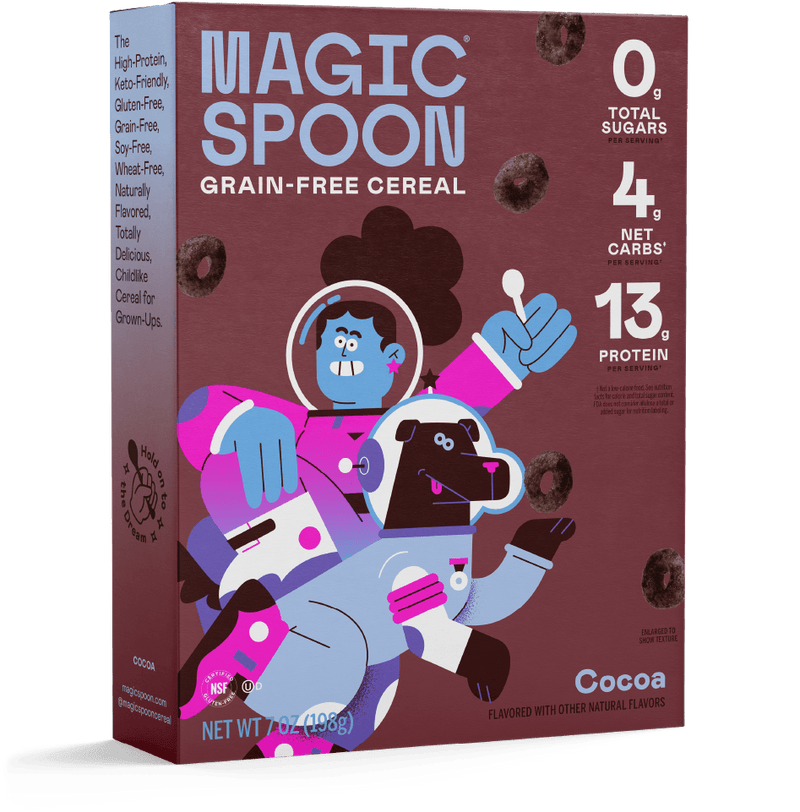
Yes. Magic Spoon makes two distinct products. The granola reviewed in this guide is Magic Spoon Grain-Free Protein Granola — a chunky nut-and-seed granola eaten dry or as a topper. The original product, predating the granola, is the puffed ring-shaped cereal eaten with milk. Both share the allulose and monk fruit sweetener system, both are grain-free and gluten-free, and both show 0g of sugar on the label. The cereal’s protein comes from milk protein isolate (casein + whey); the granola’s comes from its nut base. The cereal is nut-free; most granola flavors are not.
Magic Spoon Cereal: 2026 Nutrition Facts by Flavor
The ring-shaped cereal delivers 12–14g of protein per serving with 0g of sugar across six core flavors. Peanut Butter is highest in protein (14g) and calories (170); Cinnamon Roll is lowest in protein (12g). All values are verified from current product nutrition panels (Oct 2026).
| Flavor | Serving | Calories | Protein | Total carbs | Fiber | Sugar | Fat |
|---|---|---|---|---|---|---|---|
| Fruity | 38g | 150 | 13g | 15g | 1g | 0g | 8g |
| Cocoa | 37g | 140 | 13g | 14g | 2g | 0g | 7g |
| Frosted | 37g | 140 | 13g | 14g | 1g | 0g | 7g |
| Peanut Butter | 36g | 170 | 14g | 10g | 1g | 0g | 9g |
| Cinnamon Roll | 37g | 140 | 12g | 15g | 1g | 0g | 7g |
| Blueberry Muffin | 38g | 150 | 13g | 15g | 1g | 0g | 8g |
Source: current Magic Spoon product nutrition labels (Oct 2026). True net carbs (excluding allulose and fiber) are approximately 4–5g per serving.
Compared to the granola, the cereal is lighter: 140–170 calories per serving versus 260, because the puffed-ring format lacks the fat-dense nut base. The protein per serving is nearly the same (12–14g vs. 14g). Both products use the same allulose sweetener logic — allulose appears in total carbs per FDA labeling rules but is minimally metabolized — which is why both show 0g of sugar alongside 10–15g of carbohydrates on the label.
Bottom line: Magic Spoon and Nature Valley Protein Granola arrive at nearly the same protein number from opposite formulations. Magic Spoon is the grain-free, low-sugar, higher-fiber, higher-fat option built for people who care about sugar and net carbs. Nature Valley is the cheap, widely available, high-added-sugar option built for people who want protein per dollar and are not restricting sugar or gluten. Both are honest at what they do — and both are best used as toppers on Greek yogurt or cottage cheese rather than as a primary protein source. Compare the full field in our best protein granola brands ranked, or browse the protein snacks directory for more breakfast protein options.
Shop our top protein cereal picks
Editor-selected high-protein options related to this guide. As an Amazon Associate we may earn from qualifying purchases.
Buy the products in this guide: Variety 6 · Variety 6 - Protein Cereal - 6 box case · Treats Super Pack
10g protein12g protein11g proteinProtein Pastries - 24 Pastries
Amazon returns policy · secure checkout
Tags
High Protein Snacks Pro Editorial Team
Independently researched and editorially reviewed. We compare real nutrition labels and never accept payment for coverage.
Get the best new protein snacks in your inbox
Weekly picks and honest reviews — no spam, unsubscribe anytime.
More from the journal
Best Protein Cereal 2026: 7 High-Protein Cereals Ranked by Protein, Sugar, and Cost Per Gram
Magic Spoon Frosted delivers 12g of protein and 0g of sugar per 35g (~1 cup) serving for about $1.32 per serving. Kashi GO Original wins on price per gram of protein at grocery — 13g of protein and 8g of fiber for roughly $0.55 per serving. This is every popular high-protein cereal in 2026 ranked by real per-serving protein, sugar, fiber, and cost per gram of protein — plus which ones are honest value and which trade the front-of-box protein claim for a heavy sugar load.
Read more
Best Protein Oatmeal Brands 2026: 7 Picks Ranked by Protein, Sugar, and Real Ingredient Quality
Kodiak PEAK delivers 20g of protein per instant packet at 290 calories — the most protein of any hot oatmeal packet in mainstream grocery. Bob's Red Mill Protein Oats gets to 10g with one ingredient (hulless oats, no added protein powder). This is every major protein oatmeal brand in 2026 ranked by verified protein per serving, added sugar, and ingredient quality — including which ones actually deliver on the protein claim and which pad it with cheap additives.
Read more
Best High-Protein Snacks (2026): 10 Category Winners Ranked by Verified Nutrition Labels
Country Archer Zero Sugar Classic is the best beef jerky, FAGE Total 0% is the best Greek yogurt, and Quest Chocolate Chip Cookie Dough is the best packaged protein bar — one verified pick per category across ten snack formats, ranked on real 2026 nutrition labels with honest sweetener and sodium disclosure. Every pick has 15g+ of protein per serving (or protein-per-100-calorie efficiency that matters more), a clean enough label to defend, and a tracked buy link — with the honest catches on each one so you can pick the right pick for your goal.
Read more